How Speech Therapy Works: What Happens in a Typical Session?

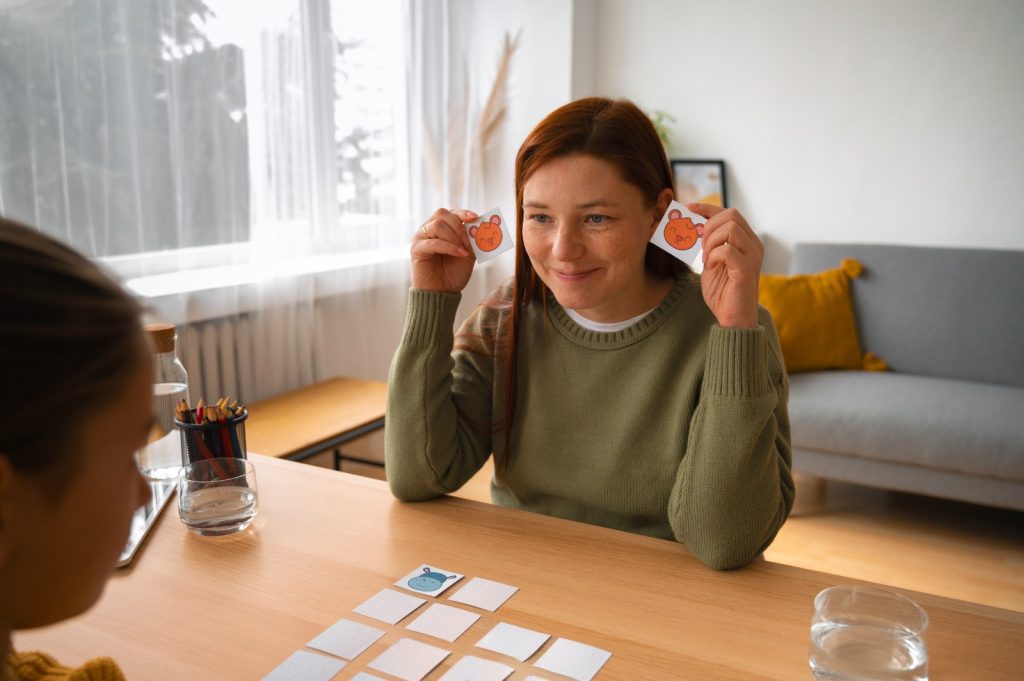
Forget the picture you might have in your head — a child at a desk, a stack of flashcards, a therapist holding a mirror. Modern paediatric speech therapy looks more like guided play than drill. There is a structure underneath, but the surface of a good session is warm, child-led, and often surprisingly fun.
If you are searching to understand what happens in a speech therapy session before you book one, you are likely asking three quiet questions. Will my child be okay in the room? Am I supposed to sit outside and wait, or stay and help? How on Earth will I know if it’s working?
This article walks through all three — what happens before the first session, what a typical 1-hour visit looks like, and what “progress” honestly looks like over time.
Not ready to read the whole thing? [Learn what happens before your first appointment →]
Before the first session: intake and goal-setting
Therapy doesn’t start with intervention. It starts with a 1-hour detailed assessment — a structured play-based observation, a parent interview, and a developmental history review. The point of that hour is to understand your child as a whole person before a single goal is written down. The therapist must get to know your child’s needs, even if he/she has been already evaluated by a different professional.
From the assessment, the therapist builds a tailored treatment plan with two to four prioritized goals. These might be foundational (sustained joint attention, regulation during transitions) or production-focused (combining two-word phrases, intelligibility of certain sounds, fluency strategies) — it depends on what your child needs first.
Goals are written in plain language, not jargon. You see the plan before therapy begins, so there are no surprises in week one. For a fuller walk-through of the very first visit, see what happens before your first appointment. If you are still earlier in your research, a beginner’s guide to speech therapy for children covers the basics.

What a typical 1-hour session looks like
Every session flexes around the child’s regulation and energy on the day, but the underlying structure tends to follow the same arc. Here is how the hour usually unfolds.
First 5–10 minutes — settling in and connecting
The opening minutes are about meeting the child where they are. A sleepy child needs a different entry point than a wired one; a child who arrived from a difficult school day needs another. The therapist reads the room, lowers the demands, and uses play, song, or quiet activity to settle the nervous system.
Joint attention and engagement come first. They are the soil. Sound production, vocabulary, and conversation skills are the plants. Without the soil, the plants don’t take.
30–40 minutes — guided play and targeted work
This is the bulk of the hour. Therapeutic goals are embedded inside play activities the child enjoys, and the method shifts depending on what the child needs.
- For a toddler with a language delay, the work often looks like a shared book or pretend-play scene, with the therapist modeling target words and pausing to invite a response. This is the territory of the Hanen parent-coaching approach — natural, conversational, language-rich.
- For a child on the autism spectrum, sessions may follow a DIR/Floortime structure: the therapist follows the child’s lead into their play, opens “circles of communication,” and builds engagement and two-way interaction step by step.
- For a child with motor speech difficulty, the therapist might use light tactile cues on the jaw or lips during a structured sound game — the PROMPT approach — to help the muscles find the right placement.
- For a child who stutters, the work centres on smooth-speech games and gentle conversation practice, drawing on the Lidcombe Program for stuttering with most of the daily practice happening at home with you.
- For a minimally verbal child, picture-symbol exchange (PECS) might be embedded inside a snack request or a toy choice, giving the child a working way to communicate while spoken language continues to develop.
How does speech therapy work for toddlers in practice? Usually quieter and more parent-led than it looks in the brochures — a lot of pointing, naming, waiting, and modeling, woven into things the toddler is already interested in. Tons of following the child’s lead. Even more joyful engagement to focus on foundational skills. In most of my sessions I incorporate DIR/Floortime method, what means equipping you, parent/caregiver with the skills necessary to promote child’s skills. It might mean you will be the one playing and interacting with the child, while the therapist is turning into your assistant.
Last 10–15 minutes — wrap-up and parent coaching
The therapist invites you in (if you weren’t already there). Most of the time we prefer for you to sit through the entire therapy, walk you through what was worked on, and demonstrates one or more specific strategy.
The role of play in a session
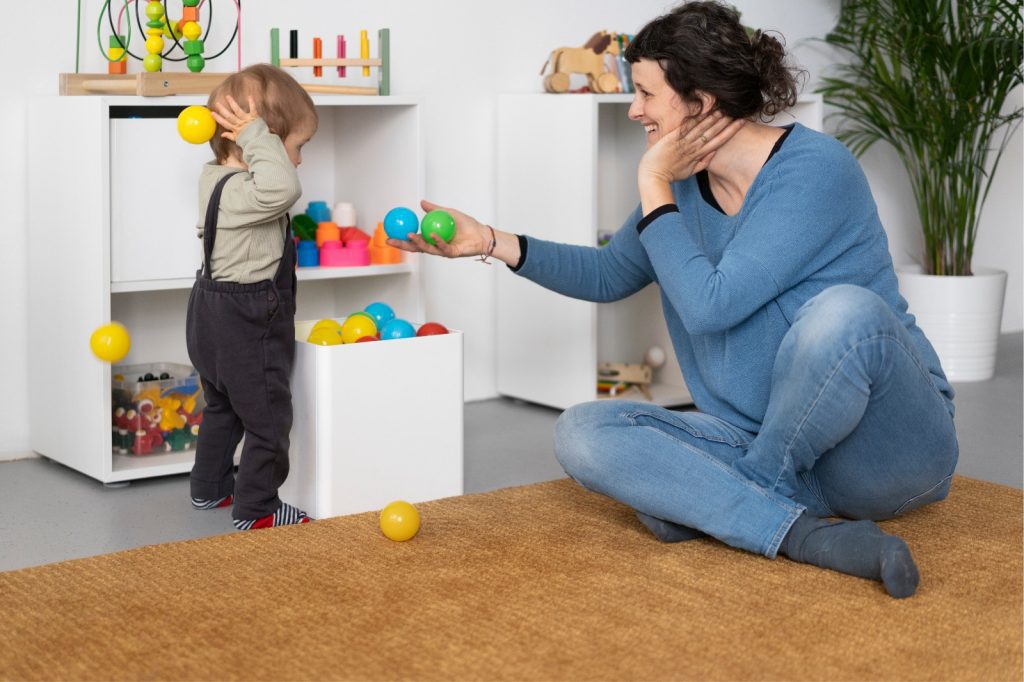
Children don’t learn language from drills. They learn it from meaningful interaction with people they’re connected to. Play is the most reliable engine for that interaction, which is why it sits at the centre of modern paediatric therapy.
DIR/Floortime as a play-based approach is used heavily with children on the autism spectrum and those with developmental differences, as well as with everyone else that comes to our clinic. It is not an approach designed for specific challenges, but rather a therapeutic philosophy of supporting the child as a whole. The therapist follows the child’s lead into whatever they’re interested in — trains, animals, a sensory toy — and uses that interest as the gateway to engagement, shared problem-solving, and ideation.
The Hanen programs work alongside this from a different angle. They are parent-coaching models — It Takes Two to Talk for language delays, More Than Words for autism — that teach you how to turn ordinary playtime at home into a language-rich moment. That coaching happens in the session room.
What is the parent’s role in the room?
A lot of parents arrive expecting to drop the child off and read in the lobby. That isn’t how this works.
You are often in the room observing for the first part of the session and joining for the coaching portion. The therapist’s job is not only to work with your child for an hour. It is to make you the most effective communication partner your child has for the rest of the week.
The Maths is simple. You have around 167 waking hours a week with your child. The therapist in average has 1. The session matters because of what travels home with you, not just what happens inside the room.
In my 20+ years of clinical practice, the strongest predictor of progress at home isn’t the child — it’s the adult who walks into the next session with one new strategy already tried. That’s the Hanen parent-coaching programs and DIR/Floortime at work, and it’s the quiet thing that makes therapy stick.
What “progress” actually looks like — session by session
Here’s the honest part. Progress in speech therapy is rarely linear.
Some weeks a child takes a clear step forward — a new sound, a longer phrase, a calmer transition. Some weeks it looks flat. Some weeks it can look like a small regression, often because the child is integrating a new skill underneath the surface, or because they’re tired, unwell, or in the middle of a developmental shift elsewhere (sleep, school, a new sibling, a holiday). Plateaus are normal. They often sit just before the next leap.
What matters more than the week-to-week shape is whether specific, observable behaviours are moving against the goals in the treatment plan. Not “is my child talking more” in a vague feeling sense, but: is the new sound being attempted; is the two-word combination emerging in spontaneous play; is the moment of shared attention lasting a beat longer than it did six weeks ago.
For many children, small functional wins are the real story. A request made with two words instead of one. A fleeting moment of eye contact at the dinner table. A stutter handled with a strategy the child has practiced. These are the wins worth counting.
Goals are reviewed with the parent every six to eight weeks as a typical cadence, though it depends on the goal and the child. The review is a conversation, not a report card.
Between sessions: home strategies and parent coaching
The hour in the clinic is the lab. The week at home is where the learning settles in.
After every session, you leave with one specific home strategy, or a repetition/variation of the strategy you already knew — a narrated routine at mealtimes, a modeled phrase to use during play, a particular oral-motor exercise, a picture-symbol layout for a tricky transition. This is not homework in the school-report sense. It’s a small, repeatable adjustment to ordinary daily moments — the bath, the walk home, the snack before bed.
The technical word for using a skill outside the therapy room is generalization, and it is the real measure of progress. A child who can produce a target sound only in the clinic hasn’t quite learned the sound yet. A child who uses it spontaneously asking for water at home and for instance school has. That’s why home practice matters as much as the session itself — it’s where the PROMPT approach for motor speech difficulties and every other method earns its keep.
How often, and how many sessions?
Most families in Singapore attend weekly or more frequently. The right cadence depends on the goals, not the diagnosis. Some children benefit from a short intensive block; some do better with longer gaps and steady parent-led practice between.
A reasonable first review point is six to eight weeks in. At that point the therapist and parent look at the goals together and decide whether to keep going as planned, adjust the focus, or step down to a lower cadence. There is no fixed “course length.” Every plan is individual.
Not ready to message yet? [Learn what happens before your first appointment →]
Frequently Asked Questions
The BubbleBee standard is 1 hour. Inside that hour, the structure flexes around your child’s regulation, energy, and goals on the day — there’s a settling-in phase, a guided-play work phase, and a parent-coaching wrap-up. The hour stays the same; what fills it adapts to your child.
Most of the time the answer is “absolutely yes”, but sometimes it might not be possible. It depends on your child’s age and goals. Toddlers and Hanen-aligned work usually involve the parent for most or all of the session. Older children may have part of the session one-on-one, with you invited in for the final coaching portion. The default leans toward you being present and involved.
This is common and not a problem. The first session prioritizes regulation and connection, not “performance.” A tearful or reluctant start does not predict how the rest of therapy will go — many children settle into the room within two or three visits as the relationship with the therapist builds.
Progress is tracked against specific, observable goals set in the treatment plan — not a vague feeling. The therapist reviews progress with you every six to eight weeks. Plateaus and non-linear weeks are normal and expected; what matters is whether the goal-level behaviours are moving over time, not week by week. You can always ask the therapist how things are progressing.
We work alongside you by offering practical strategies and solutions that fit naturally into your daily routines. Instead of overwhelming parents with many techniques, we focus on one small, consistent adjustment at a time — because steady practice in everyday moments is often what creates lasting progress.
Most families attend weekly or more frequently. The right cadence depends on the goals and your child, not the diagnosis. A first review at six to eight weeks is typical — that’s when the therapist and parent revisit the plan together and decide whether to continue as is, adjust, or change cadence.
Taking the next step
If you can picture your child in the room now — settling in for the first ten minutes, playing through the middle, leaving with one strategy in your pocket — and you’d like to talk it through, that’s the next step.
A 1-hour detailed assessment gives you clarity. Whether the answer is “therapy would help your child” or “your child is developing within range, here are home strategies,” you will leave knowing what to do next.
WhatsApp us at +65 9721 0336 for a no-pressure chat about whether an assessment is right for your child.
Not ready to message yet? [Learn what happens before your first appointment →]